
Cooling: access to credit
Access to credit in India has expanded substantially over the past few decades through rural social banking, bank nationalisation and targeted financial inclusion policies, yet large segments of the population remain excluded from formal credit and continue to rely on informal lenders. Household and village-level studies based on National Sample Survey and other data show that formal credit penetration is strongly skewed towards better-off households and more developed regions, while poorer households typically borrow from informal sources at much higher interest rates, often exceeding 36 percent.
These aggregate patterns mask pronounced inequalities along class, caste and gender lines. Households in higher asset quintiles and with the presence of at least one adult with a high‑school education or more are strongly associated with borrowing from formal financial institutions, while poorer and less educated households are confined largely to informal credit markets. Caste shows to have an independent effect: Scheduled Caste and many manual worker households have much lower access to formal loans than upper‑caste and dominant‑caste groups, leaving them more dependent on high‑cost informal lenders and with much smaller average loan sizes.
When it comes to cooling, particularly air conditioning, the high cost of these cooling technologies often requires households to rely on credit or accumulated savings. Yet, as mentioned, caste remains an important determinant of financial access in India. While earlier studies explained unequal access to loans by differences in human and physical capital, the findings here point to an additional constraint: marginalized castes appear to face structural barriers in formal credit markets. These barriers can limit their ability to finance costly adaptation investments. Three patterns emerge:
- First, marginalized caste households are slightly more likely to take out loans than upper-caste households.
- Second, upper castes are significantly more likely to obtain loans from banks, reinforcing evidence of persistent financial inclusion gaps.
- Third, lower-caste households rely more heavily on informal borrowing, particularly loans from relatives and friends.
This reliance on informal networks suggests that caste-based social ties function as financial safety nets, partially compensating for restricted access to formal lenders. However, informal credit may be less stable, more expensive, or insufficient for large investments such as air conditioning.
Additional evidence from saving behaviour points in the same direction: marginalized households are less likely to hold fixed deposits in banks or post offices, indicating more limited access to formal financial instruments.
These results suggest that inequalities in climate adaptation are shaped not only by income differences, but also by unequal access to credit and savings mechanisms.
Date:
17 Marzo 2023
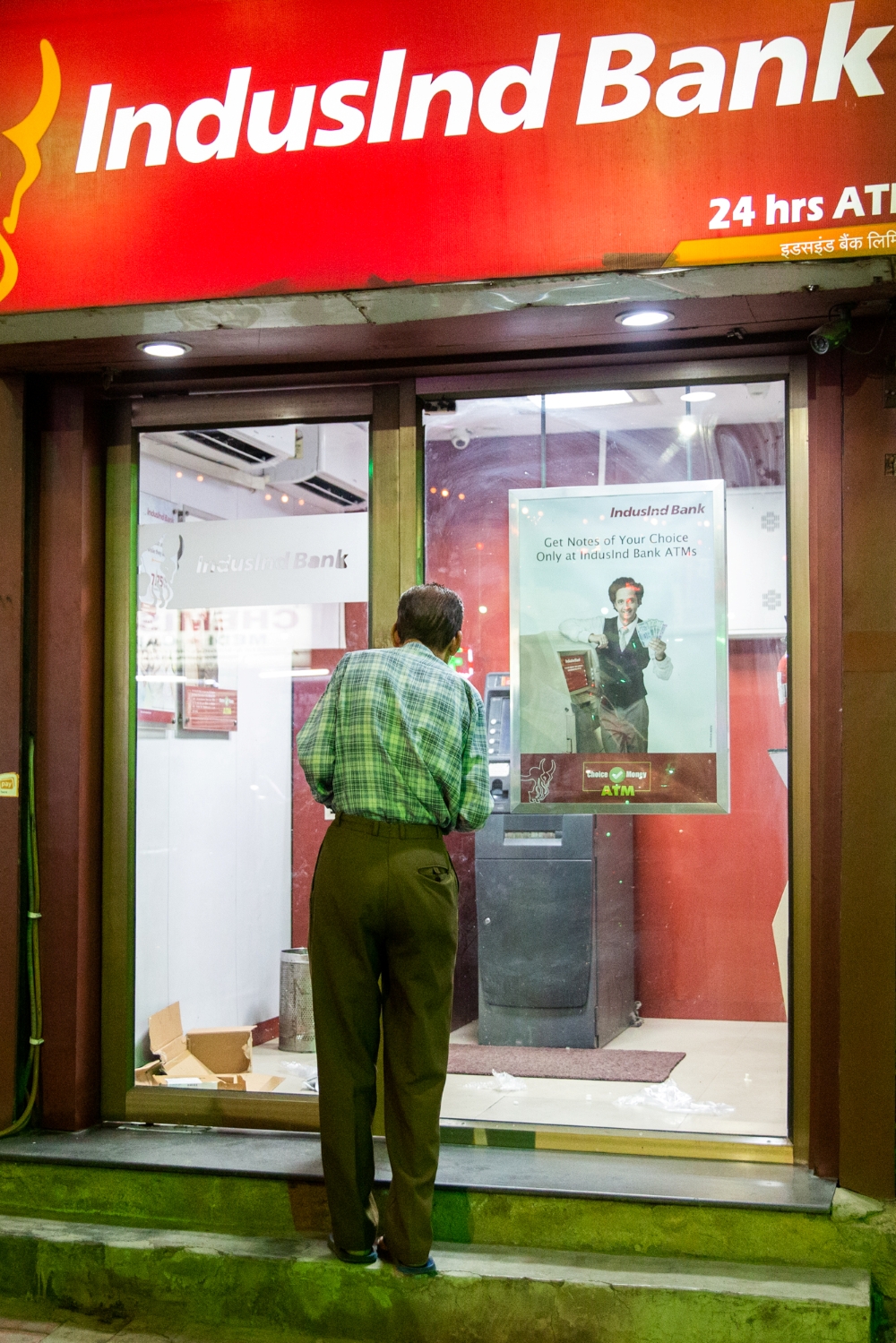
A man peers into a bank from the street. New Delhi, India. © Gaia Squarci