
Caste and Children
The cast system also defines educational disparities which manifest in both the quality of schooling and the outcomes of that education. Intense segregation persists, with nearly 30% of schools enrolling 90% or more students from a single caste category. Even when lower-caste individuals attain higher education, they often experience lower economic returns compared to upper-caste peers with the same qualifications.
Caste remains one of the most powerful determinants of children’s life chances in India, shaping access to education, health, and nutrition from an early age. As an inherited system of social stratification, caste structures economic opportunities and social interactions across generations, becoming a key channel through which inequality is reproduced over time (Munshi, 2019). A growing literature shows that children from disadvantaged castes perform worse in educational and cognitive outcomes, not only because of lower household resources but also due to discrimination and social exclusion, particularly in settings dominated by higher castes (Bailwal and Paul, 2024).
The Indian Mid-Day Meal Scheme (MDMS), one of the world’s largest school-based nutrition programs, offers a unique lens to examine whether public policy can mitigate these caste-based disadvantages. By providing free meals to children attending public schools, the program directly targets nutritional deprivation while also encouraging school enrolment and attendance among economically and socially disadvantaged families. Exploiting variation in children’s cumulative exposure to the program in Andhra Pradesh, the paper “The Effects of the Indian Mid-Day Meal Scheme on Cognitive and Health Outcomes of Children in Andhra Pradesh” by Cavapozzi et al. shows that the MDMS has a positive impact on children’s health and cognitive outcomes among public school students.
Crucially, these benefits are highly uneven across caste groups. The positive effects of additional exposure to the MDMS are concentrated almost entirely among children belonging to disadvantaged castes – Scheduled Castes, Scheduled Tribes, and Other Backward Classes – while no statistically significant effects are observed for children from Upper Castes. This pattern holds across multiple health and cognitive indicators and remains robust after accounting for differences in school selection. The results suggest that the program’s overall effectiveness is driven primarily by its impact on children who face the most severe structural disadvantages.
These findings underscore the central role of caste in shaping how children benefit from public interventions. For children from disadvantaged castes, school meals play a critical role in supporting nutrition, health, and cognitive development in contexts where parental resources are most constrained. More broadly, the evidence highlights the importance of explicitly considering social identity when evaluating policies aimed at improving human development outcomes.
Date:
17 Marzo 2023
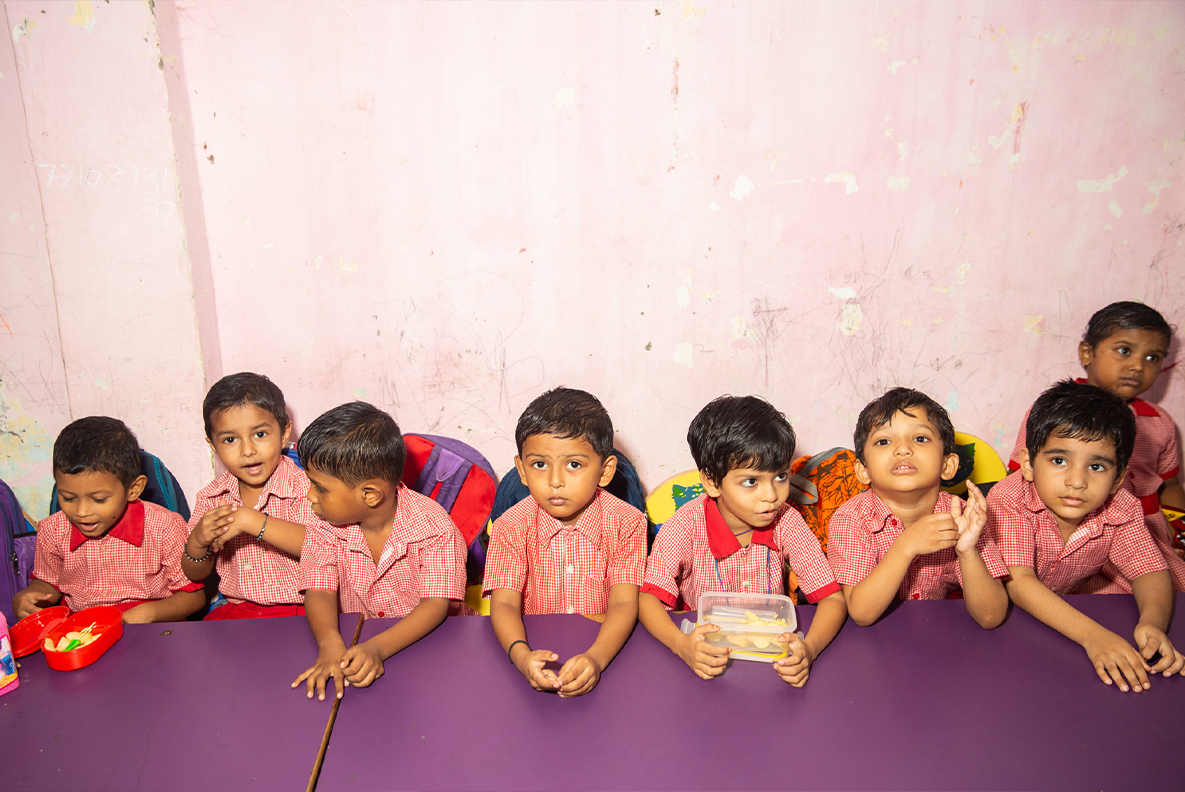
A class at St. Mary’s School, established for children from the Dalit (“untouchable”) caste, in the Geeta Nagar neighborhood, Mumbai, India. © Gaia Squarci