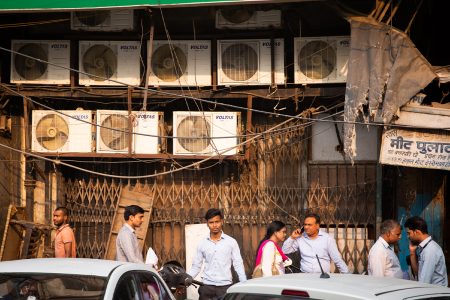

Cooling: adherence to group social norms and power structures
The study examines in detail how peer behaviour within caste groups shapes cooling decisions. Rather than acting in isolation, households may respond to the choices of socially proximate others. When a particular adaptation strategy becomes common within a caste group, it can influence what is perceived as normal or appropriate. To test this, the authors analyse whether households are more likely to own an air conditioner or a cooler when a majority of their caste peers in the same district already do so.
The results reveal strong peer effects for air conditioning. When AC ownership is widespread within a caste group, the probability of adoption increases significantly. This suggests that decisions involving highly visible, status-associated technologies are reinforced by group behaviour. The pattern differs for evaporative coolers: peer ownership has a weaker and slightly negative influence, indicating that coolers may carry less social signalling value and therefore generate weaker conformity pressures.
Importantly, marginalized caste households show greater adherence to group norms. Their adoption choices deviate less from the prevailing behaviour of their caste peers, particularly for air conditioners. This points to tighter social expectations and stronger conformity dynamics. Overall, these findings highlight that climate adaptation is shaped not only by economic resources but also by social interactions and group behaviour, helping explain why adaptation gaps persist even among households facing similar financial conditions.
Beyond peer effects within caste groups, the study examines how broader power structures influence households’ ability to adapt. The results show that Scheduled Castes, Scheduled Tribes, and Other Backward Castes are significantly less likely to adopt air conditioning, particularly when they live in upper-caste-dominated areas. This suggests that identity-based disadvantages and structural barriers are amplified when marginalized groups are surrounded by socially and economically dominant castes. These constraints appear especially strong for high-cost technologies such as AC.
For evaporative coolers, the pattern differs. While inequalities persist, OBC households are more likely to adopt coolers when residing in upper-caste-dominated districts. This indicates that proximity to economically powerful groups may ease access to lower-cost technologies, even if similar benefits do not extend to more expensive options like air conditioning.
The findings also reveal an important contrast within marginalized communities. When marginalized castes themselves are locally dominant, air-conditioning adoption increases. This points to the possibility that greater local power may relax social and behavioural constraints, enabling households to invest in more effective forms of heat adaptation.
Date:
17 Marzo 2023

A worker carries evaporative coolers in New Delhi. Evaporative cooling used to be very common in Northern India until recently. As climate change increases the humidity of the early summer, it makes these devices less and less efficient, while people who can afford it simply switch to AC units for heat relief. India. © Gaia Squarci