
Cooling: inequalities and the cast system
The dynamics across and within caste groups are particularly relevant also when households face environmental stressors such as extreme heat. Indeed, adapting to rising temperatures increasingly requires material investments within the home, making climate adaptation inseparable from consumption choices. Yet responses to heat are not determined by income alone. Even among households with comparable economic resources, decisions about whether and how to adapt can vary widely (De Cian et al., 2019). Existing studies show that marginalized caste groups exhibit distinct consumption patterns compared to Upper castes, reflecting differences in social positioning, expectations, and constraints (Khamis et al., 2012; Mitra and Ray, 2024).
Cooling technologies, such as air conditioners and evaporative coolers, sit at the intersection of these forces. They are household goods that provide protection against extreme heat, but they also differ sharply in cost, effectiveness, and visibility (Pavanello et al., 2023). Understanding who adopts which form of cooling therefore requires looking beyond income and considering how caste and social identity shape household consumption and adaptation strategies (Munshi, 2019; Deshpande, 2019).
A new paper “Does social identity influence households’ adaptation to hot temperatures?” investigates precisely the role of social identity, proxied by caste, in shaping adaptation responses to rising temperatures in India. The authors compare two widely used cooling technologies in India: air conditioning, which provides highly effective cooling, and evaporative coolers, which are far more accessible but less effective. This distinction is important because households are deciding not only whether to adapt to heat, but also how to adapt under different constraints.
The analysis builds on the social identity framework developed by George A. Akerlof and Rachel E. Kranton. Their central insight is that people care not only about income and comfort, but also about behaving in ways that align with social expectations. In the Indian context, caste represents a powerful social identity. Beyond economic resources, caste can shape norms around lifestyle, consumption, and what types of technologies are perceived as appropriate or attainable.
Household choices can be categorized as high heat adaptation (more effective technologies) or low heat adaptation (less effective options). Even when cooling improves comfort, caste-related identity pressures may affect adoption alongside economic factors. This helps explain why families may not always adopt the option that appears economically optimal. To examine these mechanisms empirically, the authors estimate a statistical model analysing whether a household owns an air conditioner or a cooler. After controlling for a wide range of household and local characteristics, they study how caste is associated with cooling adoption.
This approach moves beyond the familiar explanation that differences in cooling adoption are driven only by income. Instead, it highlights how social norms and identity pressures may also shape who adapts to rising heat, a perspective that is central to understanding inequality in climate adaptation.
The study combines household survey data with temperature records. Household information comes from the Consumer Pyramids Household Survey (CPHS) conducted by the Centre for Monitoring Indian Economy between 2014 and 2019, which tracks income, living conditions, assets, and whether households own air conditioners or coolers. Heat exposure is measured using daily temperatures from the European Centre for Medium-Range Weather Forecasts ERA5 dataset, summarized as Cooling Degree Days to reflect longer-term climate conditions. Descriptive patterns show clear disparities: Upper Caste households are much more likely to own both air conditioners and coolers than SC/ST/OBC households. While part of this gap relates to differences in income, education, urban residence, and electricity access, these factors do not fully account for the disparities. Let’s see how social and structural forces may also shape adaptation.
Date:
17 Marzo 2023
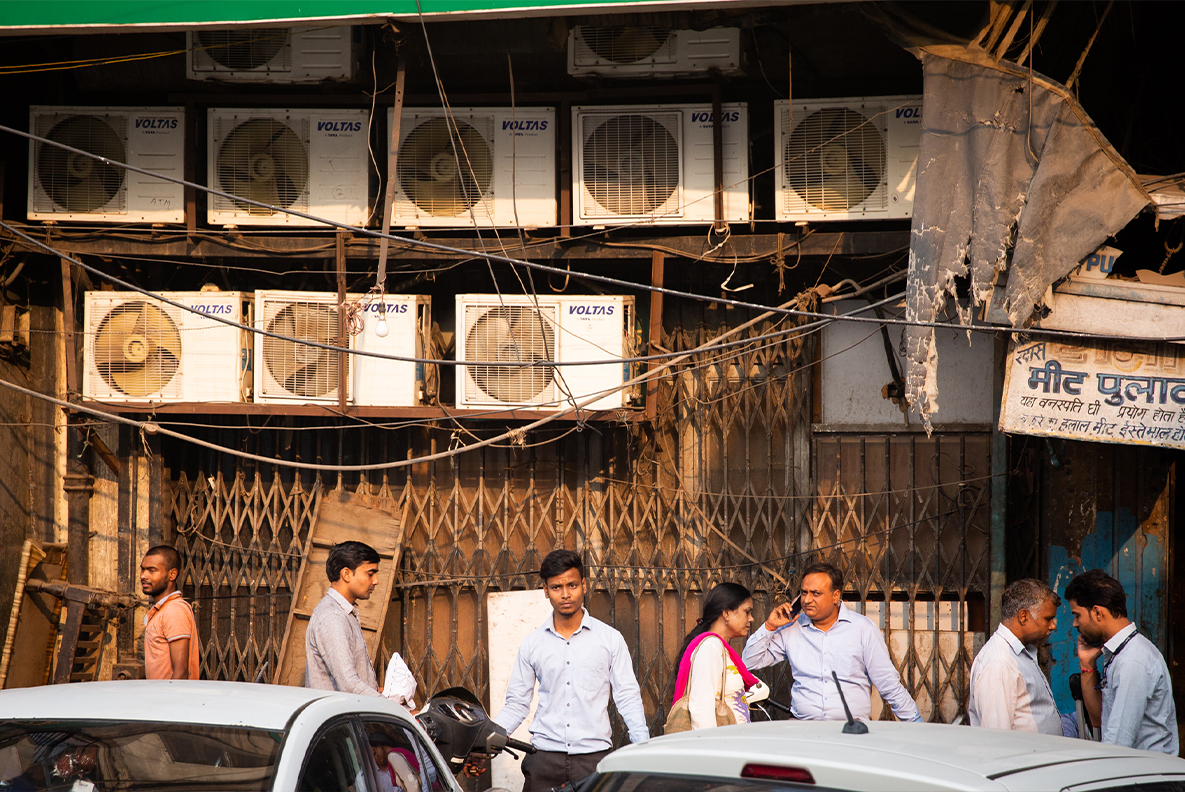
Passers-by on the streets of central New Delhi, with used air conditioning units in the background dumping heat into the street. India. © Gaia Squarci