

Inequalities and the Indian case
Over the past few decades, India has experienced a profound economic transformation, transitioning from a near-stagnant economy into one of the world’s fastest-growing major powers. Its share of the global economy more than doubled from 1.6% in 2000 to over 3.4% by 2023, while real output nearly quadrupled over the same period. Rapid growth has coincided with substantial poverty reduction: between 2015–16 and 2019–21, 135 million people escaped multidimensional poverty, and the share of the population living in extreme poverty (below $2.15 per day) declined sharply from 16.2% in 2011–12 to 2.3% in 2022–23. Despite these achievements, inequality remains a persistent feature of India’s development path, raising concerns about the inclusiveness and sustainability of economic progress.
According to UNESCO, inequality refers to the unequal distribution of resources, opportunities, and privileges among individuals or groups within a society. It manifests in various forms, including economic disparity, gender inequality, and discrimination based on race or ethnicity. Addressing inequality is essential for promoting social justice and fostering intercultural dialogue. Building on this definition, inequality can be understood as a multidimensional phenomenon that goes beyond purely economic differences. It includes social, cultural, and institutional factors that shape individuals’ life chances in unequal ways. Inequality may arise both in the outcomes people ultimately achieve—such as income, education, or health—and in the opportunities available to them from the start. These differences are often influenced by circumstances beyond individual control, including family background, gender, or ethnicity and caste. In the Indian context, these ascriptive characteristics are particularly salient, as they structure access to resources and opportunities from birth and tend to persist across generations.
The importance of inequality for economic development has long been recognized in economic thought. As early as the eighteenth century, Adam Smith argued that “no society can surely be flourishing and happy, of which the far greater part of the members are poor and miserable”. More recently, the World Bank has emphasized that equity is not only a normative concern but also a key instrument for achieving long-term prosperity.
Despite broad agreement on the relevance of inequality, its relationship with economic development remains contested. Early “classical” approaches, such as the one by Nicholas Kaldor, suggested that higher inequality could foster growth by concentrating resources among individuals with higher saving and investment incentives. Subsequent contributions challenged this view, emphasizing how inequality may hinder development through credit constraints, limited access to education, and reduced human capital accumulation. More recent syntheses highlight that inequality affects growth through multiple channels and that its long-term impact depends crucially on structural and institutional conditions.
Reflecting this broader understanding of development, modern approaches increasingly move beyond income-based measures. For instance, the Inequality-adjusted Human Development Index (IHDI) developed by the UNDP adjusts a country’s average achievements in health, education, and income to account for their unequal distribution, providing a more comprehensive assessment of development outcomes.
Date:
17 Marzo 2023
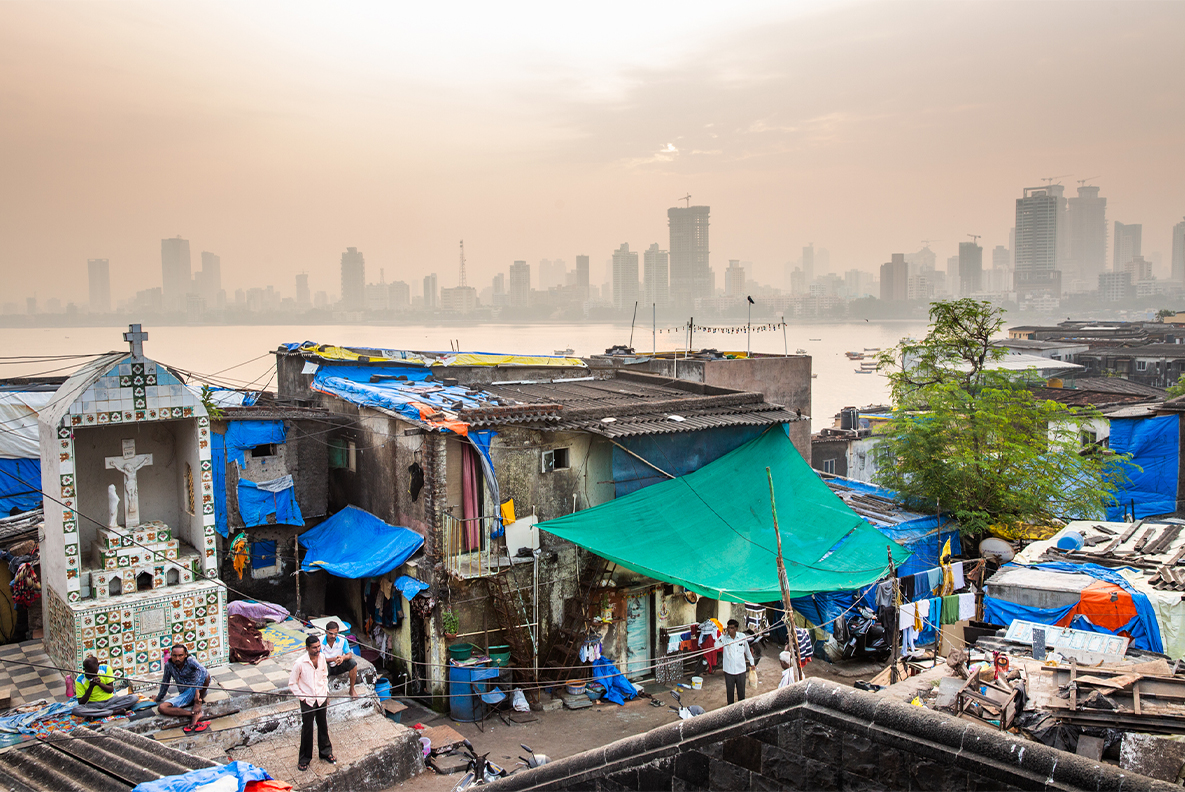
Residents stand in the streets of the fishing village of Worli, overlooking the residential buildings of Mahim, now a wealthy area of Mumbai. India. © Gaia Squarci
References
Distributive politics and economic growth.
The quarterly journal of economics , 109(2), 465-490 1994
Occupational choice and the process of development.
Journal of political economy , 84(2), 755-776 1993
Inequality does cause underdevelopment: Insights from a new instrument.
Journal of development economics , 84(2), 755-776 2007
On the impact of inequality on growth, human development, and governance.
International Studies Review , 24(1), viab058 2022
Income distribution and macroeconomics.
The review of economic studies , 60(1), 35-52 1993
Alternative theories of distribution.
Review of Economic Studies 23 , 94–100. 1956
Capital accumulation and economic growth.
In: Lutz, F.A. Hague, D.C. (Eds.), The Theory of Capital. St. Martin's Press, New York 1961
Is inequality harmful for growth?
American Economic Review , 84: 600-621 1994
World Development Report 2006: Equity and Development.
Washington, DC: World Bank 2006